
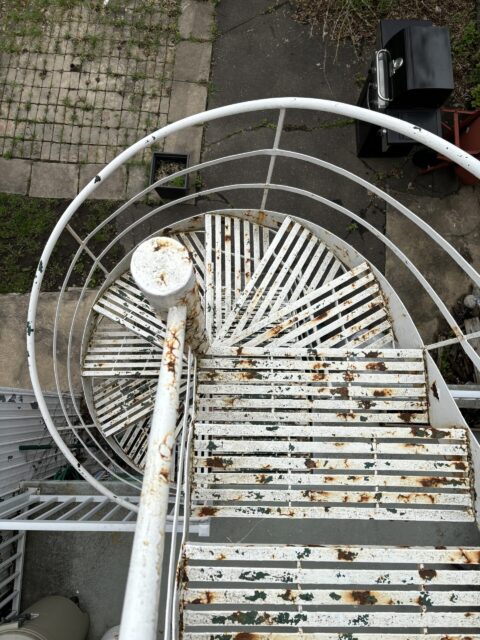
It’s one of the most frustrating situations for a property owner: a staircase or guardrail repainted barely a year ago, and the rust is already back. The first reflex is often to blame the paint itself, but the reality almost always lies elsewhere. Such a quick failure can almost always be explained by one or two specific factors in how the work was done, not by the paint itself.
Here are the most common causes of wrought iron rusting again after only a season or two, and what needs to change for the next intervention to truly last.
The Most Common Causes of Quick Failure
| Cause | What happens | Visible sign |
|---|---|---|
| Insufficient preparation | Paint is applied over rust or leftover dirt | Localized peeling, often in the same spots as the old rust |
| No anti-corrosion primer | Nothing blocks moisture between the metal and the finish | Blisters that appear quickly, even on fresh paint |
| Standard paint instead of industrial | The protective film is thinner and less resistant | Quick fading and rust returning within a year or two |
| Application in the wrong temperature or humidity | Drying and adhesion are compromised from the start | Paint that stays tacky or peels off in patches |
| Wrong mixing ratio on a two-component product | The chemical reaction that gives the product its strength doesn’t happen properly | Finish that stays soft, sticky or comes off in whole sheets |
This last point is often underestimated: industrial paints are frequently two-component systems that must be mixed in precise ratios and applied according to the manufacturer’s technical data sheets. A wrong mix, even a slight one, compromises the strength of the final product, no matter how good the preparation was. It’s work that calls for the expertise of a contractor experienced with these products.
The Underestimated Role of Metal Preparation
In the field, preparation is by far the most common cause of quick failure. Painting over light rust without complete stripping amounts to trapping the problem under a new coat rather than solving it. Corrosion then keeps spreading underneath, out of sight, until it resurfaces as blisters or peeling, often in exactly the same spots as before.
A well-executed restoration project always starts with complete stripping of the affected areas, not just surface sanding.
Why Skipping the Primer Costs You in the Medium Term
Anti-rust primer is neither an optional nor a cosmetic step: it’s the layer that truly creates the barrier between the metal and moisture. Without it, even an excellent finish paint only delays the inevitable by a few months. That’s one of the reasons why industrial paint, designed as a complete system rather than a simple finishing product, offers far more lasting protection than a consumer paint applied on its own.
A previous restoration that didn’t hold up?
An on-site assessment can pinpoint exactly what was missing the first time, and redo the work properly, this time for good.
How to Tell Poor Workmanship From Normal Wear
Not every reappearance of rust is necessarily a sign of failure. Here’s how to tell normal wear, expected over time, from a problem related to how the previous work was done.
| Observation | Normal wear | Sign of poor workmanship |
|---|---|---|
| Time before the first rust | Several years (5 years or more) | Less than 2 years after application |
| Location | Most exposed areas (base, welds) | Often exactly where the old rust was |
| Paint appearance | Gradual, even fading | Blistering, peeling in patches |
What We Change When Redoing a Failed Restoration
- Complete stripping, down to bare metal on the affected areas, rather than settling for light surface sanding.
- Anti-corrosion treatment on already oxidized areas, even before the primer is applied.
- High-solids primer, applied systematically, without exception, on all prepared surfaces.
- Industrial finish (epoxy or polyurethane) rather than standard paint, for protection that truly lasts several years.
For an overview of the habits to adopt on an ongoing basis after a successful restoration, our guide on how to prevent rust on exterior wrought iron is a great complement to this approach.
Don’t repeat the same mistakes
A free quote establishes the right diagnosis and proposes a restoration that truly holds up, this time.
FAQ: Wrought Iron Rusting Quickly After a Restoration
Why is my wrought iron already rusting when it was just repainted?
The most common cause is insufficient preparation of the metal before application, or the lack of an anti-corrosion primer. Without these steps, rust keeps spreading under the new coat.
Is it normal for wrought iron paint to blister after only a year?
No, that’s not a normal timeframe. Properly applied paint, with adequate preparation and primer, generally lasts several years before showing signs of weakness.
Does everything need to be stripped again if the first restoration failed?
In most cases, yes, at least on the affected areas. Applying a new coat over failed work generally reproduces the same problem quickly.
Can standard paint be to blame?
Yes, in part. Standard paint offers thinner, less durable protection than a complete industrial system, especially on structures exposed to salt and freeze-thaw cycles.
How can I avoid going through the same problem next time?
By making sure the restoration includes complete stripping, anti-corrosion treatment of oxidized areas, a high-solids primer and an industrial finish suited to Quebec’s outdoor climate.

What our customers say













No comment yet, add your voice below!