

A guardrail dotted with orange spots, a staircase that’s peeling, a fence that has lost its shine: when faced with rusted wrought iron, the first reflex is often to wonder whether restoration is really worth the cost, or whether it’s better to replace everything. Good news: in the vast majority of cases, rust doesn’t doom a wrought iron piece. What determines the answer is the real extent of the damage, not how it looks.
This article explains how to properly assess the condition of your metal, what a professional restoration can fix, and in which rare cases replacement becomes the only reasonable option.
Why Rust Doesn’t Mean the End of the Piece
Rust is a gradual process. It first attacks the paint layer, then the surface of the metal, and only affects structural integrity after prolonged exposure without any intervention. In other words, a piece that looks damaged on the surface often keeps all its strength underneath. Wrought iron is a thick, durable material: that’s exactly why it has been used for exterior staircases, railings and fences for generations.
The real issue is therefore not cosmetic, but structural. A well-executed restoration removes surface rust, treats the metal in depth and applies a protection system that keeps corrosion from coming back. That’s exactly the logic behind a well-executed wrought iron restoration project.
How to Assess the Extent of the Damage
Before deciding anything, you need a clear diagnosis. Here are the three levels most often seen in the field, and what they really mean.
| Observed condition | What it means | Verdict |
|---|---|---|
| Orange spots, dull paint | Surface rust, metal intact underneath | Standard restoration, very cost-effective |
| Peeling, blistering, visible pitting | Corrosion spreading under the paint | Full restoration with stripping |
| Crumbling metal, sections with holes or bent | Loss of material, compromised structure | Replacement of affected sections only |
The last scenario, where the metal is literally holed or weakened to the point of bending, is by far the rarest. In the vast majority of inspections, we’re in the first two rows, where restoration remains the most logical solution, both in terms of cost and durability.
What a Professional Restoration Can Really Fix
- Complete stripping removes rust and old coats of paint that are no longer doing their job.
- Metal treatment stabilizes already oxidized areas to keep corrosion from spreading under the finish.
- Anti-corrosion primer creates the barrier that actually protects the piece, unlike a simple coat of paint applied over rust.
- Industrial finish (epoxy or polyurethane) withstands the elements, de-icing salt and UV rays for several years.
Note: industrial products are often two-component systems that must be mixed in precise ratios and applied according to the manufacturer’s technical data sheets. One more reason this type of work calls for a contractor experienced with these products, rather than a simple can of paint bought at the hardware store.
Unsure about the condition of your wrought iron?
An on-site assessment can tell you within minutes whether a standard restoration is enough or whether some sections need to be replaced. Request your free quote for a clear picture of the situation.
Repaint or Replace: The Real Comparison
Replacing a wrought iron structure generally costs several times the price of a restoration, not to mention fabrication and installation delays. Here’s an overview of the comparison for a medium-sized structure, such as a staircase or balcony guardrail.
| Option | Typical cost | Timeline | Result |
|---|---|---|---|
| Professional restoration | $3,500 to $25,000 depending on scope | A few days | 5 to 8 years of protection, renewed appearance |
| Full replacement | Often 2 to 4 times the cost of restoration | Several weeks (custom fabrication) | New structure, but a much higher expense |
In the vast majority of cases we see in the field, restoration offers far better value for money, while preserving the original character of the structure, whether it’s a century-old staircase or a more recent guardrail.
Real-Life Example: A Staircase Neglected for Several Years
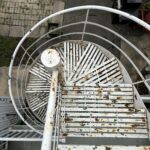
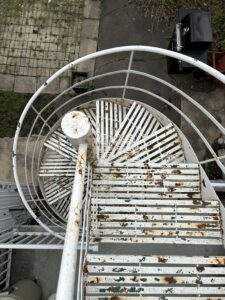
Take the exterior staircase of a duplex, never maintained since it was installed about ten years ago. The original paint has completely disappeared from the steps, and rust covers a good part of the railings. At first glance, many owners would be tempted to consider a full replacement.
After inspection, the metal is still solid everywhere: only the protective layer is gone. Complete stripping, treatment of the oxidized areas and the application of a complete industrial system (high-solids primer and polyurethane finish) are enough to make the structure like new, for a fraction of the price of a replacement.
When Restoration Is No Longer the Most Logical Option
There are rarer situations where a section truly needs to be replaced rather than restored: a baluster rusted all the way through, a weakened structural weld, or a section bent by an impact. Even in these cases, it’s rarely necessary to replace the entire structure: only the affected sections are isolated and replaced, then the rest is restored and protected as usual.
Extend the lifespan of your wrought iron
An on-site assessment helps determine the right intervention, from a simple touch-up to a full restoration. Also check out our wrought iron restoration guide to understand each step of the process.
FAQ: Restoring Rusted Wrought Iron
Can heavily rusted wrought iron really be saved?
Yes, in the vast majority of cases. As long as the metal isn’t holed or bent, rust remains a surface problem that stripping and a suitable protection system can fully correct.
How do I know if my metal is too damaged to be restored?
The most reliable signs are holes, crumbling metal that flakes when touched, or bent sections. Outside of these cases, a standard restoration is generally enough.
Can I just paint over the existing rust?
No, that’s the reflex to avoid. Painting without stripping and without an anti-corrosion primer hides the rust without treating it, and corrosion keeps spreading under the new coat.
How long does a properly done wrought iron restoration last?
With a complete industrial protection system (suitable primer and finish), it’s generally 5 to 8 years before more significant maintenance is needed, with simple spot touch-ups in between.
Do you need a specialized contractor to restore wrought iron?
For light rust, basic maintenance can be done yourself. As soon as a large surface needs to be stripped or a complete anti-corrosion system has to be redone, a specialized contractor’s expertise ensures a lasting, uniform result.

What our customers say











No comment yet, add your voice below!